Plantar Fasciitis in Vaughan: Why Heel Pain Keeps Returning and How to Fix It

Why Plantar Fasciitis Is One of the Most Stubborn Conditions We Treat

Plantar fasciitis is among the most frustrating musculoskeletal conditions — primarily because it responds poorly to passive treatment and patience alone. If you’ve been stretching your calves, wearing orthotics, and resting for months with limited improvement, you’re not doing anything wrong. You’re just not getting the right treatment.

What Plantar Fasciitis Actually Is

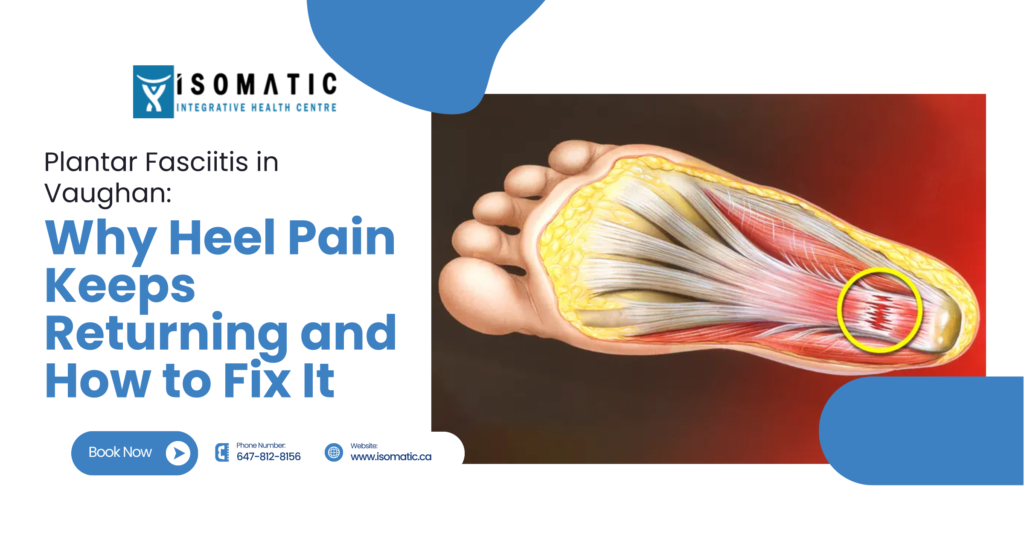
Plantar fasciitis is a degenerative condition of the plantar fascia — the thick band of connective tissue that runs along the sole of your foot from the heel to the toes. Despite the ‘itis’ suffix suggesting inflammation, research consistently shows that chronic plantar fasciitis is primarily a degenerative (rather than inflammatory) condition. This is why anti-inflammatory medication and ice have limited long-term effect.

Why It Keeps Coming Back

Most treatments target the foot in isolation. But plantar fasciitis is almost always driven by factors higher up the kinetic chain: calf and Achilles tightness, reduced ankle dorsiflexion, weak hip abductors and glutes creating excessive foot pronation during gait, and foot intrinsic muscle weakness. Without addressing these drivers, the plantar fascia continues to be overloaded — regardless of what’s done at the foot level.

What Works at Isomatic Vaughan

BioFlex Laser Therapy is one of the most effective treatments for plantar fasciitis — stimulating collagen synthesis and accelerating repair in the degenerative fascial tissue. Physiotherapy addresses the calf flexibility, ankle mobility, and hip strength deficits that are overloading the fascia. RMT soft tissue work on the calf, Achilles, and plantar fascia reduces the tension contributing to the problem. Gait analysis identifies whether pronation, supination, or stride mechanics are contributing.

What About Orthotics and Night Splints?

Orthotics can reduce load on the plantar fascia during recovery — they are a support tool, not a cure. Night splints maintain dorsiflexion during sleep and reduce morning pain. Both can be helpful adjuncts but don’t address the underlying drivers. Our Vaughan team will guide you on whether these tools fit your specific situation.

Book a Plantar Fasciitis Assessment in Vaughan

Book at isomatic.ca or call (647) 812-8156.

Related Posts

50% Off Of Our Initial Assessment!

40% Off Of Our Initial Assessment!